Global Community Food for Human Nutrition and Planetary Health in Small Islands (Global CFaH)
Improving household health and food security by promoting agroecological community-based food production
The Global Community Food and Health Project (Global CFaH) builds on collaborations that have been established over many years.

Aim
The Global CFaH project aims to address four key research questions over its four-year life span by promoting increased community-based food production (CFP) based on agroecological principles in small island countries:
- What is the potential for improving household diet, nutrition, and food security, and reducing the burden of nutrition-related diseases?
- What are the likely economic and social impacts across the food value chain?
- What are the likely impacts on ecosystem health?
- What are the drivers and barriers to change and the adoption of agroecologically-based CFP?
Through training and capacity-building activities, the project also aims to strengthen interdisciplinary research capacity that supports policy and practice for more sustainable food production and improved population nutrition.
Activities
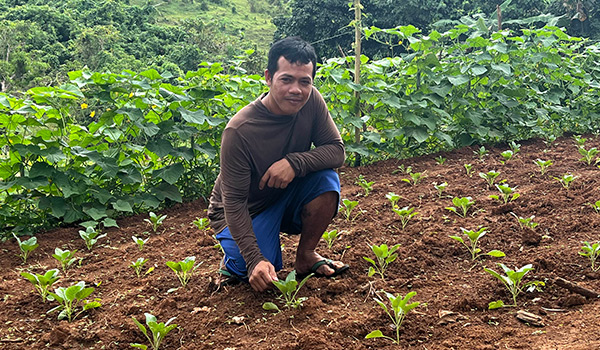
We are working with communities in Fiji, the Philippines, and St Lucia and St Vincent and the Grenadines in the Caribbean.
Our approach engages local stakeholders in food system mapping and co-creation, using ‘Living Labs’ in which setting-specific interventions and theories of change with measurable outcomes are designed in each of the four locations. Stakeholders include local communities, government, local businesses and civil society.
The project began with a comprehensive review of the available data on dietary quality, nutrition-related diseases, food sourcing, and the extent to which community food production (CFP) uses an agroecological approach. This work involved screening over 20,000 articles and assessing the full text of 525 studies.
After identifying key data gaps, we engaged with over 1300 households, collecting new data focussing on population and household diet and nutritional status, the contribution of food sources to diets, and the socio-cultural, historical and economic contexts. We also examine enabling factors such as local and national governance and policy frameworks.
We are working closely with local communities and local food producers to assess their needs and co-design, deliver and evaluate interventions to increase local sustainable food production.
We will model the long-term human and ecosystem health benefits of these interventions, as well as their scalability against ‘business as usual’ scenarios to inform national and regional policy and practice.
Outcomes
The co-designed project activities are intended to deliver the following outcomes:
Fiji
- Greater diversity of food crops
- Greater household dietary diversity
- Improved household income
- More climate‑resilient food gardens
Palawan (The Philippines)
- Greater dietary diversity
- Greater crop diversity
- Improved soil quality
- Increased knowledge of integrated pest management
- Enhanced skills in food processing and healthier cooking methods
St. Lucia
- Increased knowledge of diet, nutrition and health among farmers and farmers’ market customers
- Increased knowledge of food preparation using local crops
- Greater demand for, and consumption of, sustainably produced local food
St. Vincent & the Grenadines
- Greater diversity of food crops
- Increased food security and dietary diversity
- Increased household income
- Increased social capital
Follow-up data collection before the end of the project will help to evaluate the extent to which these have been achieved.
Outputs
Our planned outputs range from data and scientific evidence and policy guidance to community level interventions and tools to community resources.
Research and Data Outputs:
- Generate datasets on household diet, nutrition, and food security in Fiji, the Philippines, St Lucia, and St Vincent & the Grenadines
- Comparative analyses of agroecological practices in community food production
- Publish peer-reviewed publications in nutrition, public health, and agroecology journals
- Produce policy briefs, reports and publications to inform governments, NGOs, and researchers.
Practical and Community Outputs:
- Co-designed and delivered community interventions with local communities and food producers to strengthen sustainable food systems (e.g. backyard gardening, nutrition education, health cooking recipes using locally grown food, agroecological farming methods)
- Develop living lab training materials and toolkits to support adaptation to other regions
- Training modules for local producers and community leaders.
Community Engagement Outputs:
- Project team CEI reflections highlighting the experiences, challenges and triumphs of the CEI process
- Participant reflections highlighting how involvement in the project has influenced their understanding of local food systems and health; changes in confidence, skills or motivation to engage in community-based food production; the impacts of the interventions; the benefits, challenges and unintended consequences of participating in the project activities; and how their contribution shaped project decision, priorities or intervention design.
- Community reports tailored for households and local organisations
- Conference presentations and workshops with international organisations
- Media and outreach content (videos, blogs, social media posts) to share progress widely
- Share findings through workshops, conferences, and outreach activities to build wider impact.
Strategic Outputs:
- Models of long-term health and ecosystem benefits
- Scalability frameworks to guide further adaptation and expansion of successful interventions
- Dissemination and communication plan.
Partners
Research partners:
- European Centre for Environment and Human Health
University of Exeter, UK (Lead) - George Alleyne Chronic Disease Research Centre
The University of the West Indies, Barbados (Co-Lead) - Faculty of Food and Agriculture
The University of the West Indies, Trinidad - Pacific Centre for Environment & Sustainable Development (PaCE-SD)
University of the South Pacific, Fiji - Natural Resource Sciences
McGill University, Canada - MRC Epidemiology Unit
University of Cambridge, UK - Western Philippines University
Palawan, Philippines - Foundation for Rural Integrated Enterprises and Development (FRIEND)
Fiji - James Hutton Institute
Scotland, UK - University of Galway
Ireland

Funder
NIHR Global Health Research Group [NIHR134663]